

//essay version 1.0.0
tragedy of the concept
the concept
A colleague leaves the room in tears, the potential clients are stumped. Don Draper just finished his pitch for the new Kodak projector in Mad Men’s ‘The Wheel’ episode, the first season episode of the series Mad Man, about New York advertisement agency Sterling Cooper in the 1960’s 1. Draper, portrayed by Jon Hamm, is the star ad men and pitches the name ‘Carousel’ for Kodak’s wheel-shaped projector. It’s a designer’s dream to have a presentation like Draper’s, pitching their ideas. An aspiration that needs to be reconsidered.
Traditional solutions in the field of urban development don’t work anymore. That’s why, above all, the word ‘concept’ needs to be considered. The word is used in various ways. It’s slapped on products, only to be removed once the product reaches its final version. The concept refers to the preliminary version. In some design fields, the word is used for the first actual physical manifestation of the design, a concept car for instance. It’s a prototype, ready for mass production. And then there is ‘conceptual architecture’, giving the concept yet another definition. Concept can also be considered in a more philosophical or Platonic sense as a general notion or idea, an archetype. For that matter a word itself can be considered a concept.
The concept has proven to be very useful. What would a world without words be? It has helped to transfer ideas from one person to another. Almost everything nowadays is conceptualized however, from facial expressions, to food, to online personas, to nightlife, to entire landscapes. Add a hashtag, post it, and people will know instantly what it intends. It goes beyond the archetype.
an eroding phenomenon
As useful as it has been, the utility of the concept is eroding. What would a world be without words? Well, a world without words is quite an interesting one, as it turns out. Neuroanatomist Jill Bolty Taylor lost her entire vocabulary after a stroke 2. After she regained it, she told she had felt the world in a much more intense way. She had felt a strong sensation when a ray of sunlight or a breeze touched her skin. It made a profound impression on the scientist. When asked the question in what state she’d rather be in, a state with or without words, she can’t decide which state she prefers 3.
For every description of a word, as careful as it might have been made, the only possible conclusion is that it is flawed. The late physicist David Bohm urged people, pay attention to your thoughts before going into dialogue. Pick a word, and your notion of it will be quite different then the next person’s 4 5. A personal thought is probably not entirely correct. ‘Cogito ergo sum’ Descartes concluded, ‘I think, therefor I am’. He didn’t say ‘I think, therefor I am right’.
David Bohm on dialogue and thought
Humans’ continuously failing attempts to grasp the living world in concepts equally has a rather amusing history, as wonderfully written by Carol Kaesuk Yoon. Aristotle started to categorize nature, and much later, Linnaeus started to name plants. Then Darwin came along and concluded the living world isn’t in a fixed state. With the emergence of the computer, animals were categorized anew, which turned out to be completely flawed when genetics were discovered 6.
With the latest discoveries, it turns out that the dynamics of genetics are quite different then earlier conceived, rendering the human genome project a senseless exercise 7. Philospher Koert van Mensvoort provocatively points out it’s increasingly hard to distinguish the concepts of nature and technology, refering amongst other things to convincing cases as CRISPR-cas technology and the engineered Dutch natural reserve Markerwadden 8.
Indeed it can be hard to let go of a concept, even when it is proven wrong. How does your brain react to the conclusion that fish don’t exist? There’s consensus among scientists that the category ‘fish’ isn’t correct 9. Mammals fit their category, as do reptiles, insects and amphibians. The ‘fish’ category however, not so much. It turns out that genetically, lungfish are more related to cows than to salmon 7.
Kate Raworth, on her part, concluded that textbooks on economics, among other things, do not consider the value of a parent raising a child. Is there any employer who wants to hire a person that wasn’t raised properly? Yet, no economic value is given to it in the textbooks 10. Equally, economic theories assume that a human being is a rational person that will use their money in the most sensible way, is a flawed concept, proven wrong through the extensive studies by Daniel Kahneman 11.
The concept is entirely blown to pieces by quantum theory, which attempts to understand the way the universe works. Things can be in two opposite states at the same time, are entangled even though far apart, are both a particle and a wave. Quantum theory forces scientists to abandon existing concepts and can hardly be called a concept itself, it’s a different way of thinking entirely. As physicist Robbert Dijkgraaf puts it, those who claim to understand the quantum theory don’t understand the quantum theory. It merely provides a higher level of confusion 12.
the verbal and the physical
Sir Ken Robinson pointed out in 2006 that the entire educational system is focused to develop one side of the brain. The whole system seems to have the sole purpose of delivering academics who use their bodies as transportation for their heads, carrying a vast amount of concepts. Gillian Lynne told Robinson she hadn’t been doing well at school as a young girl; she could hardly sit still. After consultation, a doctor concluded she’s a dancer and advised her parents to take her to a dance school. When they did, Lynne walked into a world of people like her, only to become a famous dancer, choreographer and teacher 13.
Plato is at the root of the academic structure we know today. Robinson points out that only in the 20th century that the humanities were added, with drama and dance below art and music. Both are still below mathematics and languages. Ironically, Plato considered the mastery of dance to be the most important inquiry in a person’s development. Dance, he found, was the one expression involving the faculties on all levels: spiritual, intellectual and physical. If a person failed to master it they were referred to as a ‘danceless’ person.
Dance was used to gain understanding of the Kosmos. ‘Mousike’ was the art of the muses, including song, poetry, drama, declamation and instrumental music; the ancient Greeks didn’t make a distinction. It didn’t became part of the academic structure however. Perhaps because it is hard to write down how to dance. ‘Arete’ however, the many sided excellence of style, manner and accomplishment was regularly exhibited and honoured in national festivals such as the Olympian and Pythian games 14.
Findings by Mehrabian and Ferris, published in 1967, stated that less than 10% of communication is verbal, over 50% is body language and tone of voice and volume accounting for the remaining percentages 15. It’s said that the findings have to be nuanced and are often misinterpreted. The percentages vary per setting and culture. The key take away however, words are only a fraction of our communication, is proven by just about every movie. Scenes starring John Krasinski and Bradley Cooper in the movie Aloha portray this in a hilarious way 16.
Nonverbal communication, a scene from the movie 'aloha' (2015)
the concept and it’s application
It’s not just in science and economics where concepts play a role, concepts are increasingly part of daily life. A job, nowadays, has to be a career. A stay-at-home mother is conceptualized into the ‘trad wife’ phenomenon. Meeting somebody becomes something entirely different when it’s considered a date. A projector becomes a carousel. Whether it is an agenda, expectations, instructions, imagination, a theory; concepts are loaded with it and creates larger ideas in our minds taking word beyond the Platonic. It alters our notion, leading to the Kantian conclusion we cannot observe the thing-in-itself, ‘das ding an sich’, anymore. Or, as writer Amanda Hess put’s it, reporting on the waning trad wife movement, women are ‘being sold a dream’ only to discover the concept is merely a mental corset not aligning with reality 17.
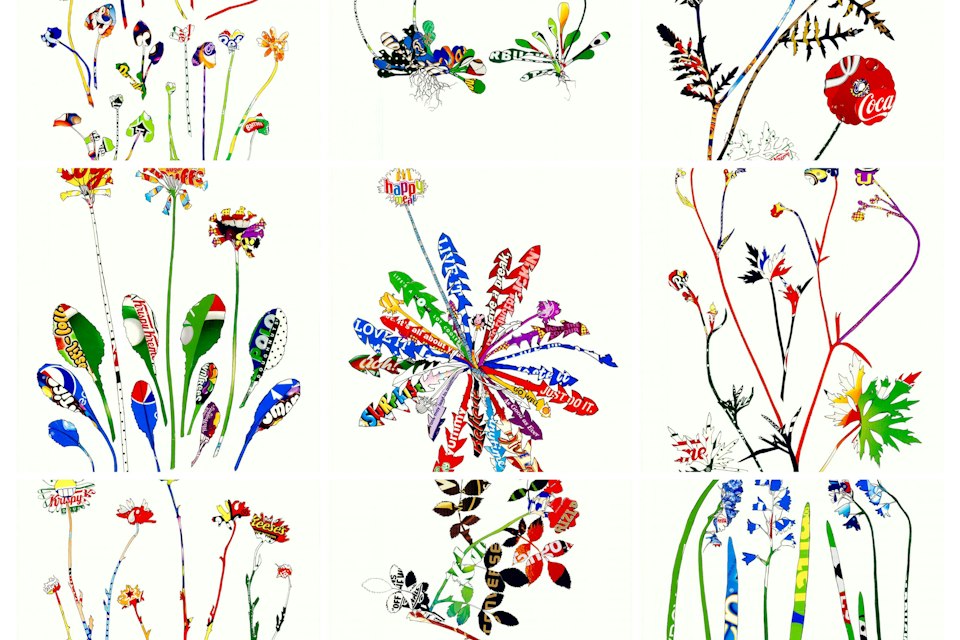
The concept has proven to be particularly useful in the 20th century economy. Draper conceptualizes the projector with the word ‘Carousel’ upon which a campaign can be built, and Kodak can start selling their mass produced projectors. Nowadays, people are bombarded with information through an array of media, every product demanding attention. Author Paul Hawken noted that an average western person is barely able to recognize ten wild flowers yet is able to distinguish approximately a thousand logos and brands 18. Yet, van Mensvoort points out the irony that many logo’s make use of animals or plants 6. He invites his readers to look around and see how many logo’s with a natural element they can identify in their surroundings
Commercials and social media spread one flawed concept after another, using mind tricks derived from Kahneman’s research, rarely mentioning health risks and impact on the environment. With ‘caveat emptor’ (buyer beware) seemingly as a guiding principle. A disclaimer used in stock markets meaning the buyer is responsible to find out how flawed the product is before buying it. If it turns out you’ve been sold junk, it’s on you, the buyer. Similar conclusions can be drawn about politics in post-truth era. The concept is often becoming a blatant lie, only increasing the need for a post-concept era 19. Especially in a world, with many kinds of intelligences, where the artificial seems to become omnipresent.
As the concept is an elusive phenomenon, it’s akin to songs one hums along without actually understanding the lyrics. It’s catchy, easy to remember, but often surprising once it becomes apparent what the lyrics actually say. It rarely matches the notion one has of a song after humming it along for a certain period. Perhaps you can think of such a song yourself. Instead of zooming in on the song, zoom in on the previous examples of the actual dynamics of a job, mother, meeting. One will find craftmanship, care, interaction. They all require endless practice, exploration, attention. They require effort.
If there’s anything you should take from this essay, it’s a little game, similar to van Mensvoort’s invitation, to spot logo’s containing natural elements. Instead, look around and try to spot the conceptual. While you’re at it, consider what the non-conceptual equivalent would be. As Bohm would say, your notion of the conceptual is probably different from the next person’s. So, when you care to share your thoughts with other, make it a dialogue, an exploration.
the concept and spatial design
Spatial designers (architects, urban designers, landscape architects) nowadays are confronted with a multitude of issues that need to be addressed. In this context the conceptual design is starting to feel rather misplaced, inappropriate even. Whereas conceptual designs are very useful for projects that have to be sold there is an increasing need for projects that help solve. This is in particular the case in the Netherlands, the country of ‘Dutch Design’.
In the current housing crisis cooperative housing is an obvious solution. They offer an answer to a lot of contemporary issues around affordability, sustainability, mobility, energy transition, changing demographics and health care. Although there were housing cooperations in the Netherlands, the practise practically vanished after the 1901 ‘Woningwet’. No cooperative housing tradition was built in the 20th century 20. Less then 1% of the houses in the Netherlands are cooperative. In Vienna an 17,8% of the houses are cooperative 21. In Germanic and Scandinavian countries, it’s quite clear, what a housing cooperative is as people have visited and experienced them 22. In the Netherlands however, people still have a hard time grasping cooperative housing. Hardly anybody lives this way, so it’s hard to observe.
Cooperative housing has a cascade of consequences. A group of people decides how they want to live. The architect helps them to organize the building, and therefor is merely a facilitator, a guide. Inevitably, conceptual architecture becomes redundant. Pitching a design or concept like Draper does is no longer the case. There is no pitch to be held, no dream to be sold, merely a tailored spatial design that solves. Designing a housing cooperative requires a very specific set of skills from an architect, a set of skills that can hardly be trained academically.
Furthermore it’s hard to communicate a cooperative design through traditional imagery. As a group decides how they want to live, the render, to sell a project to potential buyers or renters, becomes obsolete. Also a picture of an existing housing coop is not very useful. It is only by visiting and exploring a housing cooperative that it becomes clear the spaces are organized, used and maintained quite differently. The relation between spaces and the subtle things happening in them become apparent during that visit. Information that is hard to catch in a picture.
An interesting parallel is happening in landscape architecture. For centuries the notions of French and English landscape architecture have prevailed with large open spaces and short-cut grass 23 24. Such lawns have been applied in abundance in public space design. This practise is increasingly being abandoned. Landscapes stimulating ecology are more and more integrated in public spaces. These landscapes cater to local species, an entirely different maintenance plan is adopted. The corset that is conceptual design is being abandoned in favor of a much richer design, a design in cooperation with nature.
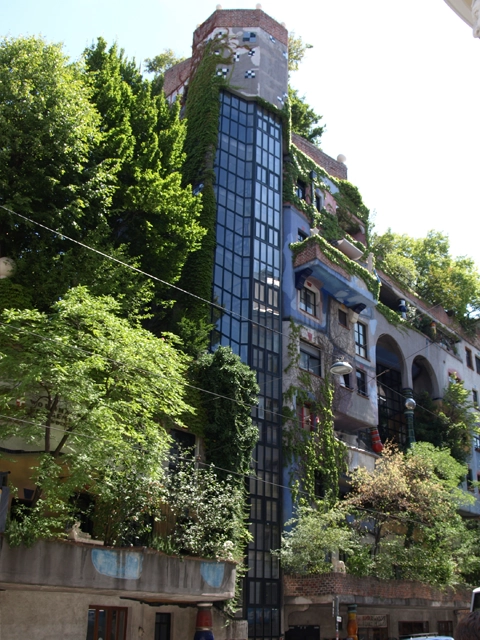
artistiek
Hundertwasserhaus, Vienna (1985)

Conceptueel
Bosco verticale, Milan (2014)

Coöperatief
Amsterdam Vertical (2024)
Three projects that combine building with nature. In the eighties artist and activist already realized the Hundertwasserhaus. Three decades later Bosco Verticale is copied worldwide. Amsterdam vertical takes an ecological approach and contains vegetation that caters to local species.
a new design practise
Both in architecture and landscape architecture, cooperative design is not the easy to grasp concept that prevails. It is the tailored design, rich with life. This requires a mind shift and perhaps even a paradigm shift. When a lawn is turned into an ecologically rich field, it might come across as messy in the concept-oriented mind. In Draper’s pitch, the word ‘carousel’ becomes so potent because he charges it with pictures of him playing with his children, kissing his wife and their wedding. He shows them the richness of his life. The pitch wouldn’t have worked without it, the carousel is merely an empty object, a projector.
Cooperative housing, and cooperatives in a broader sense, equally raises questions about urban design. There’s a tendency to prescribe a certain set of rules to shape the buildings and spaces. Just as human beings, animals need connections between places too. It’s mind boggling to see the migration patterns of animals, in particular on a global scale 25. Housing cooperatives need a certain spatial freedom organizing themselves. These routes and cooperative freedom will inevitably lead to different urban design and plans. Urban design is parametric design, the way parameters are defined subject for reconsideration.
This essay is inherently flawed, trying to grasp something in words while stating that it isn’t possible. A contradictio in terminis one could say, proofing itself wrong. Numerous concepts are used to get the message across, though lacking the knowledge of a schooled philosopher, linguist, economist or scientist but rather merely that of an observing urban designer. Albeit quite the paradox, it’s an attempt to lay down a fundamentally different approach to the practise of urban design and development. Whether it’s the buildings or the spaces between them, it’s time to accommodate the richness of life and bring back the biodiversity in both. It requires a shift from the sold to the solved, from the conceptual to cooperative.
Ronny Chieng's take on effortlessness, a clip from 'Asian Comedian Destroys America' (NETFLIX)
This requires effort, exploration and evolution away from fixed notions and concepts in a society with a tendency to make everything effortless. Above all it requires curiosity. It will create tailored designs fitted to their users. It will generate curiosities. The designer’s dream of a Draper-like carousel pitch has to be abandoned. This depart is something to celebrate. Abandoning these fixed notions will actually make the design practise a much more interesting activity.
References
- Weiner M. (2008). Mad Men ‘The Wheel’. Weiner Bros. Productions.
- Taylor, J. B. (2008, March 12). My stroke of insight [Video]. TED Talks. https://www.ted.com/talks/jill_bolte_taylor_my_stroke_of_insight
- Words. (2010). https://radiolab.org/podcast/91725-words
- Bohm, D. (2018). Over dialoog: helder denken en communiceren.
- (2018, August 11). Marleen Stikker. https://www.vpro.nl/zomergasten/artikelen/marleen-stikker fragment David Bohm
- Yoon, C. K. (2009). Naming nature: The Clash Between Instinct and Science. W. W. Norton & Company.
- Ball, P. (2025). How life works: A User’s Guide to the New Biology. Picador USA.
- Mensvoort, K., & Grievink, H. (2011). Next nature. Actarbirkhauser.
- Miller, L. (2021). Why fish don’t exist: A Story of Loss, Love, and the Hidden Order of Life. Simon and Schuster.
- Raworth, K. (2018). Doughnut Economics: Seven Ways to Think Like a 21st-Century Economist. Random House Business Books.
- Kahneman, D. (2013). Thinking Fast and Slow. INGP
- Dijkgraaf, R., Venhuizen, G., Van Der Ploeg, P., & Van Toledo, R. (2026, July 3). Robbert Dijkgraaf legt quantum uit en we begrijpen er nu nog minder van. NRC. https://www.nrc.nl/nieuws/2026/06/24/robbert-dijkgraaf-legt-quantum-uit-en-we-begrijpen-er-nu-nog-minder-van-a4930959
- Robinson, K. (2006, June 27). Do schools kill creativity? [Video]. TED Talks. https://www.ted.com/talks/sir_ken_robinson_do_schools_kill_creativity
- Pont, G. (2008). Plato’s Philosophy of Dance.
- Mehrabian, A., & Ferris, S. R. (1967). Inference of attitudes from nonverbal communication in two channels. Journal of Consulting Psychology, 31(3), 248–252.
- Crowe, C. (2015). Aloha. Columbia Pictures.
- De Koning, P. (2025, June 10). Oud-campagnestrateeg onthult strategie in Rutte-tijdperk: ‘Om van de PVV te winnen moet je het “snelle brein” van de kiezer raken.’ NRC. https://www.nrc.nl/nieuws/2025/06/09/oud-campagnestrateeg-van-mark-rutte-populisten-zoals-wilders-maken-van-democratie-een-lege-huls-a4896251
- Hess, A., Assefa, H., Winters, J., Salaberry, L., Blanco, G., & Seekamp, D. (2026, September 24). Ex-Tradwives Are Rejecting the Movement
- Hawken, P. (1993). The ecology of commerce: A Declaration of Sustainability. HarperCollins Publishers.
- Lengkeek, A., & Kuenzli, P. (2022). Operatie wooncoöperatie: uit de wooncrisis door gemeenschappelijk bezit.
- European Housing Coop. (2026, September 19). Vienna, Austria – Housing cooperatives. https://www.housingcoop.eu/cities/vienna
- Kums, M. (2024). The architecture of housing Co-Ops: 15 Case Studies in De/NL.
- Boults, E., & Sullivan, C. (2010). Illustrated history of landscape design. John Wiley & Sons.
- Schoonenboom, M. (2026, August 7). Het groene gazon gold lang als statussymbool. Nu nog steeds? NRC. https://www.nrc.nl/nieuws/2026/07/28/het-groene-gazon-gold-lang-als-een-statussymbool-nu-nog-steeds-a4933172
- There and back again. (2019). https://radiolab.org/podcast/there-and-back-again
Development log
Version 1.0.0 | September 13, 2026
This essay is the result of a thought that has evolved over seven years. The thought had to be written out as it turned out it was hard to explain in a conversation. By taking some distance from a deadline ridden life the thought could crystalize. Writing the essay took little over four months, with sentences often emerging in a clear mind during morning runs. Over a dozen of versions have preceded the one provided here. Preliminary versions were subject of two two hour philosophical sessions, many thanks to the participants. Also a lunch discussion with fellow Teilestraat creatives was helpful. The referred to sources have actually been read, watched and listened to apart from ‘The ecology of commerce’ by Hawken. His remarks inspired artist Tracey Bush to make ‘Nine wild plants’, displayed at the ‘Flowers Forever’ exhibition at Kunsthal Rotterdam, visited right before this writing this essay.
AI was used to check spelling and grammar, mainly adding punctuation and changing the occasional ‘then’ into ‘than’, was used to double check sources and provided a basis for translation, from English to Dutch. After, many sentences have been altered into more common Dutch words and expressions.
The somewhat philosophical notions need time to land in other minds, but do land which proved to be the case in above mentioned discussions. The essay supports the notion a new design practise is required in urban development, beyond the traditional.